
Research
The transition dynamics of attention
My main research line is focused on understanding transitions between attentional states. In daily life, people often have to switch attention between external and internal sources of information. For example, when grocery shopping, you might direct your attention (externally) toward scanning the shelves for the product you are looking for, after which you need to switch your attention (internally) to the next item of your memorized grocery list. In my PhD research, I have found that switching attention between these two sources is asymmetrical, in the sense that there is a larger cost for switching to internal than to external attention. In later theoretical work, I have linked this internal shielding benefit to a wide range of literatures speaking to the balancing of external versus internal attention, such as working memory, attention switching, visual search, mind wandering, and meditation. I argue that major findings in these disparate research lines can be coherently understood under this principle, which I termed the Internal Dominance over External Attention (IDEA) hypothesis.
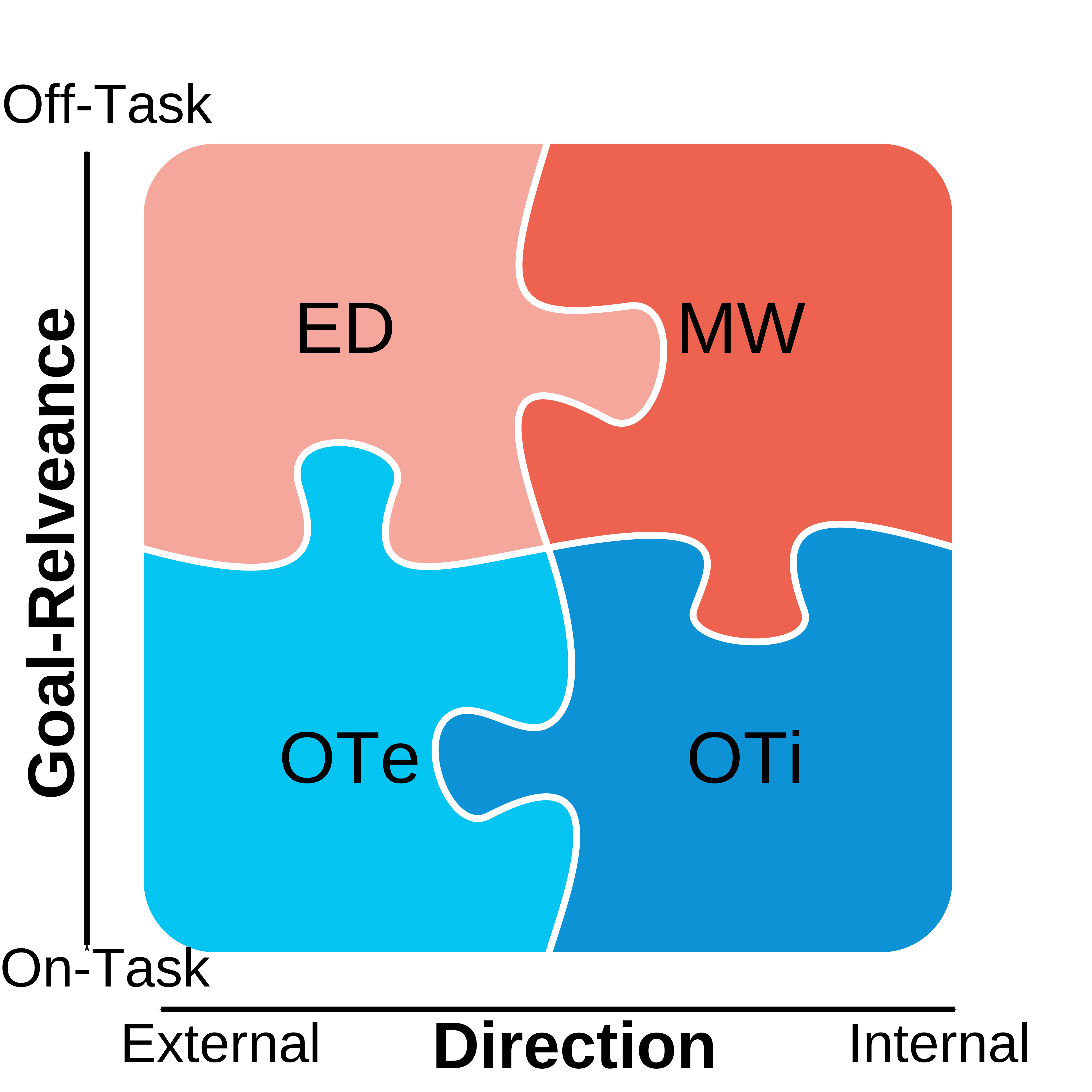
More recently, I have integrated these external-internal transitions with on- and off-task attention states. People often choose to distract themselves, either externally (e.g., looking at our phone) or internally (e.g., thinking about weekend plans), but it is not well understood how, when, or why we transition into these states. This is a pressing issue, as there currently is a war for attention going on, obstructing our capacity to focus both on personal goals and the many challenges humanity faces. The integration within a single attentional state space, defined by a Direction (i.e., external vs. internal) and Goal-Relevance (i.e., on- vs. off-task), allows me to capture the full transition dynamics of attention. I am using behavioral measures, eye-tracking, and pupillometry to capture these states and quantify the dwelling times and a transition matrix through computational modeling. Inspired by recent empirical work on attention switching and neurobiological models of attention, I hypothesize (i) the existence of an Off-Focus state through which these dynamical transitions occur, (ii) that internal bias and goal value determine which areas are visited most, and (iii) that contextual manipulations can alter the relative times spent in each area. I hope that bridging these different fields of attentional research will increase cross-talk between them and provide building blocks for interventions targeting healthy attentional engagement.
Voluntary control over the internal body (“interoaction”)
A second key research line focuses on voluntary control learning over autonomic bodily functions, such as heart rate and skin temperature. When it comes to body movements in space (i.e., “exteroactions”), people are expert in learning fine-grained voluntary control, for example when manipulating tiny objects. Ideomotor theory states that people control these movements by anticipating – or attempting to bring about – their sensory consequences (e.g., visual feedback of an arm movement). Compared to exteroactions, voluntarily controlling interoceptive rhythms inside the body (i.e., “interoactions”), such as decreasing heart rate, is much more difficult and requires dedicated training (e.g., practicing yoga or mediation). It is currently not clear how such control it acquired or why it is more difficult. To address this question, I proposed the ideomotor hypothesis of voluntary visceromotor control, which asserts that voluntary control of extero- and intero- actions are governed by the same general principle, namely the anticipation of sensory feedback. This hypothesis explains why learning to control visceromotor responses is more difficult, as its feedback (i.e., interoceptive signals from the internal body) is of lower sensory quality than the afferent signal we receive from exteroaction (i.e., exteroceptive signals from the environment). I am testing this hypothesis using autogenic and biofeedback training, which are two techniques aimed at acquiring voluntary control over visceromotor responses. If confirmed, the ideomotor hypothesis can be used to push the naturally occurring boundaries of this voluntary control, with several clinical applications.
The influence of interoceptive rhythms on attentional state transitions
My third research line tackles a stimulating novel question: how interoceptive rhythms potentially scaffold transitions between attentional states and whether we can leverage control over interoceptive rhythms to enhance attentional control. In a way, this research line can be seen as an ambitious integration of my other two main research lines. Moreover, this work also feeds into my interest in contemplative traditions, such as yoga and meditation, where a link between interoceptive control and attentional control has long been suspected (e.g., the yogic adage that “The mind cannot control the mind, only the body can control the mind”). I will hopefully be able to share some exciting updates on this work soon!